

Today I cracked open the front page of the New York Times to see what’s new. Oh, look at that some AI news at the bottom about AI liability. Oh darn, that was from a week ago, on October 1st. But isn’t there something missing?
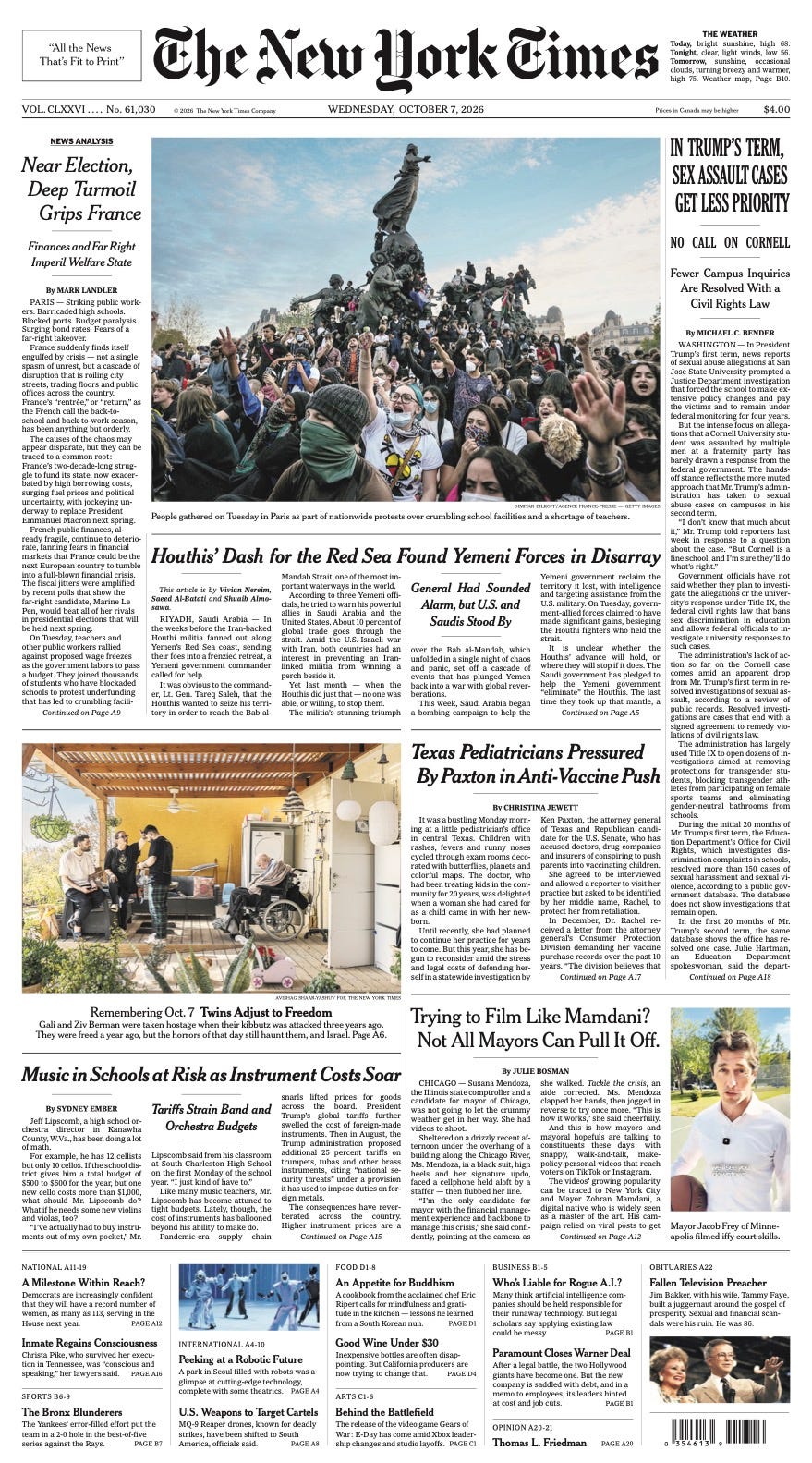
Well, of course there is. What’s missing is this: 722 mathematics papers written by OpenAI. It isn’t an overstatement to say that this is probably the biggest day of scientific advancement in history. It is hard to evaluate, but the discussion that I have been seeing is that many of these are among the hardest and most significant results in mathematics. I suspect October 6th, 2026, will go down as some form of Judgment Day for AI in mathematics, but it portends so much more.
As I noted last month, the mathematicians are struggling with what to make of all of this. They are most certainly the first significant group to “feel the disruption” of AI. (Yeah, I know, ‘coding’, but they already embraced computers.) And it is causing them to reflect on their entire project. They are just the first. Pretty much every knowledge worker is likely to face this over the next year or so.
If there is one thing that AI has spurred, it is existential questioning. When ChatGPT and, in particular, ChatGPT 4 was released, panicked journalists rang me, wondering if this was IT for them. I assured them it was not. My comfort slide was this:
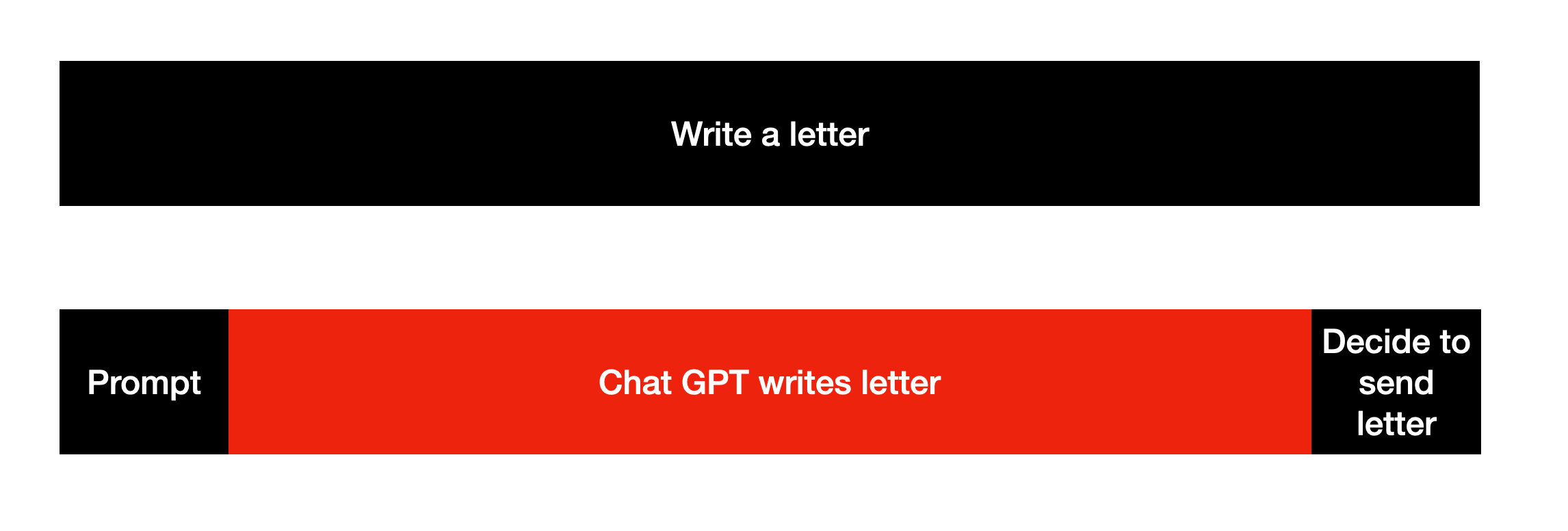
This is the “bookend” slide. We used to have a task called “writing a letter.” Then we found that ChatGPT would write the letter. However, when you thought about it, ChatGPT didn’t do this alone. First, it had to be given a prompt of what letter to write, to whom and for what purpose, etc. Then ChatGPT could write the letter. But that wasn’t it; the third and final step was that you had to decide to send the letter, aka, take responsibility for the communication. Those bookend tasks weren’t new. They were just more obvious. They were always part of “Writing a letter”, but you didn’t think about them that way. And when you thought about it more, those were both the more valuable and more enjoyable parts of the task formally known as “writing a letter.”
The same is true for the mathematicians and anyone else facing AI disruption. It is going to deconstitute tasks and jobs, and then you will need to reconstitute them. More often than not, the same person will still be part of that flow. But sometimes it will open it up to others.
Lots of people can write letters, but few people can “do maths.” Until now, that is. Now people can do maths, and what is more, people can do maths when they need maths.
This raises the question: what do the current mathematicians do? This is something I have been pondering and considering for economics research since GPT-o1 came out at the end of 2024. And my reaction to this existential challenge was to lean into it and, in some manic way, push it to see where it breaks. Now I haven’t thrown out 200-plus papers this year like some University of Chicago business school professor, but I have written a lot (maybe 40 papers over almost 2 years). There have been many times I have wondered, “what all this is for?” and my continuing to push ahead on this makes me wonder if this is all just my way of coping with existential problems. I am not confident that you can view my behaviour as necessarily the actions of someone of perfectly sound mind.
The mathematicians are now going through this. To which I offer again the above Bookend slide to help:
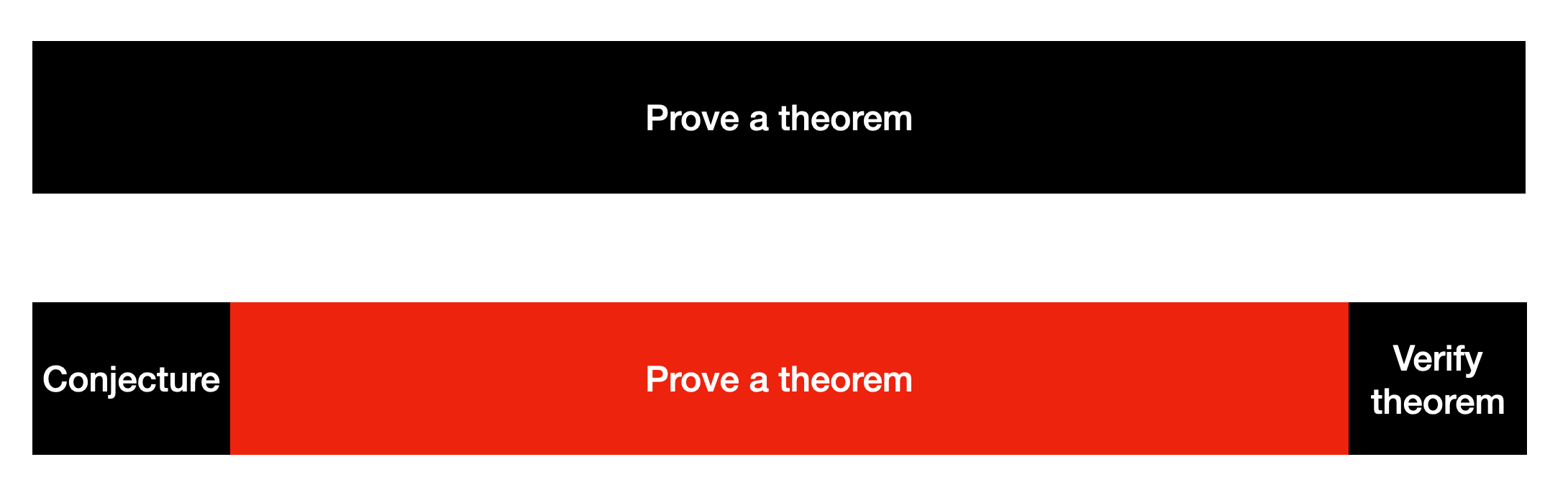
This gives some context for what OpenAI has done. First of all, the left bookend was already provided by mathematicians themselves. The conjectures and problems all existed. OpenAI’s agents were just pointed at them. They then did their work —the sort of thing mathematicians spend most of their time on —and did it quickly, even more so when you remember that AIs could barely count a couple of years ago! No small wonder the mathematicians are saying that this part of the process is a critical part of their contribution, thinking and learning in much the same way as journalists are now parading “writing is thinking.” Sure, it could be, but the messenger is not reliable in either case.
But then there is the right bookend. Part of this has been done using a language called LEAN that can verify the correctness of proofs. The other part is other people verifying the theorem and making sure what was claimed was what was proved and that it really solved the problem being posed. That still has to be done, and the only people who can do it are trained mathematicians. Basically, it is a lot of what they do now.
What this means is that the time allocation of work will change, but, in reality, the current expertise of mathematicians is not going to be cast aside that quickly.
The future is a little murkier, and transformation will likely take place. Why? Because we now have to ask: what is the usefulness of the left bookend that starts it all? Why do mathematicians make conjectures and then try to prove them? The reason is that having that proof may be useful to someone using the mathematics in the future. The conjecture is a way of predicting what might be useful and then allocating mathematicians' attention towards resolving those problems so that they are there when people need them. This is something I have called “presearch” — the task of building knowledge so that people who need it have it there, verified and ready to use.
If AI agents can do the “proving a theorem” part, however, do we really need to “pre” in “presearch”? Why not just prove the theorem when someone has a problem that needs a mathematical solution? Why not do mathematics “just in time”?
This isn’t such a fanciful notion. After all, mathematics courses are designed so people can do mathematics just in time to solve problems.
This suggests that expertise will be focused on the right bookend — signing off. AI could become quite reliable at this for many problems. The issue is working out where it isn’t quite as reliable. Part of that is making sure the right question was asked and answered before signing off. I don’t know whether this will be a thing, but it has been in pretty much every other part of knowledge work, so I am optimistic it will still be useful in the future. At least that is what my own experience in working with AI has reaffirmed over the past year. I think mathematicians and others will find their role in a similar way. It will just take some time to work out what that is.